
Research

Ongoing research
Local rare disease research projects
We conduct a range of research projects from comprehensive laboratory projects to health services research, and patient experience and outcomes measures. Patient and public input is essential to our rare disease research - several projects were initiated by patients and / or patient organisations. We have an active, dynamic research group and look forward to helping make things better for individuals living and working with rare diseases; we enjoy working with international colleagues to improve knowledge and understanding for rare diseases. Please do contact us if you wish to see your project listed here
Please do contact us if you wish to see your project listed hereLearn more about our ongoing research projects below:
-600x399.png)

COVID-19 & rare disease charities
Evaluating the impact of COVID-19 on rare disease support groups.
We are evaluating the impact of COVID-19 on groups who are supporting people with rare diseases during the COVID-19 pandemic.
There will be a £50 Amazon voucher provided to a single entry drawn at random from eligible participants.
About this project
We are keen to understand how groups that are supporting people with rare diseases have been affected by the COVID-19 pandemic. Through this project we hope to identify strategies that are working well for these groups as well as common issues to explore where the development of further resources would be most effective during this COVID-19 pandemic. This short survey is for individual or collaborative groups (including charities, voluntary, and community groups) to help evaluate the impact of COVID-19 on groups who are supporting people with rare diseases during the pandemic. The role of the charity / volunteer sector is recognised as being critically important in our society, particularly in helping minimise challenges at this difficult time. We appreciate and welcome your input to this evaluation. If you wish to provide further details and / or have any questions about this survey, please contact raredisease@qub.ac.uk using ‘COVID-19 Survey groups' in the subject line
Thank you to everyone who contributed. This project is now closed and we are summarising the results.
QR code for a quick link to the survey

PLEASE have your experiences counted by completing this survey: https://www.smartsurvey.co.uk/s/COVID19_RD_Groups/
Rare diseases are defined by the European Union as those individually affecting fewer than 1 in 2,000 individuals, cumulatively affecting 1 in every 17 persons at some point in their lives. It is estimated that 350 million people globally have a rare disease with more than 8,000 rare diseases recorded in the literature. We know that being diagnosed with a rare disease can lead to a significantly reduced lifespan and quality of life for patients and their families; accurate diagnosis and early intervention significantly improves long term outcomes for rare disease patients. Many individuals with a rare disease will regularly attend more than 5 medical professionals; many of these consultations have been delayed as a result of health and social care measures implemented for coronavirus. Access to clinical trials and medications has been severely curtailed in recent weeks. Individuals living and working with rare diseases consistently describe challenges accessing accurate information about individual rare diseases and accessing appropriate services; anecdotally this has been exacerbated in recent weeks due to the coronavirus (COVID-19) pandemic. Individuals living with rare conditions often describe feeling ‘isolated’ and ‘dismissed’ so effective communication and provision of information is critical.
We are keen to hear your views on how COVID-19 is impacting your group's activities
We aim to:
- To perform an online survey with individual or collaborative rare disease groups.
- To explore the challenges rare disease groups have faced during the COVID-19 pandemic.
- To discover the impact COVID-19 has had on the services these groups are able to provide.
- To identify the long-term implications COVID-19 will have on such groups.
- To discover where resources need developed further to help groups support those with a rare disease at this time.
What are the advantages? By taking part in this study you will be helping to identify were resources should be developed to most effectively support rare disease charity groups. We recognise the exceptional ongoing work from existing groups and by agreeing to take part in this study we hope to build resources further. There will be a £50 Amazon voucher provided to a single entry drawn at random from individuals who wish to be entered into the draw by providing their email address in the last question.
How will the results be used?
Results from this project will be collated anonymously and used to help improve the accessibility of resources and addressing the needs of individuals affected by rare disease(s) in Northern Ireland.
If you wish further information, our information leaflet and associated privacy document is available here:
Charity COVID Information Leaflet
The study was reviewed and approved by the Queen’s University of Belfast, MHLS Faculty Research Ethics Committee (MHLS 20_72).
If you would like further information on rare disease components please contact the Queen’s University rare disease team.
IMPaCCT Study
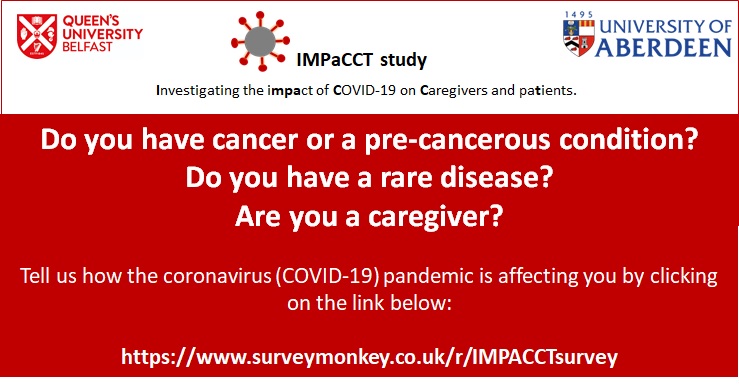
IMPaCCT Study - Investigating the impact of COVID-19 on caregivers and patients
Researchers at Queen’s University Belfast and the University of Aberdeen, invite you to take part in an online research study investigating the impact of the COVID-19 (coronavirus) pandemic on caregivers and patients with cancer, pre-cancerous conditions and rare diseases.
COVID-19 (a coronavirus) is an infectious disease caused by a virus. COVID-19 was first identified in patients in Wuhan province in China at the end of 2019. From there the virus has spread to other countries worldwide with the World Health Organisation declaring it a pandemic on 12th March 2020. This virus has had a major impact on many people with anecdotal reports suggesting patients and carers are often struggling to manage. We are particularly interested in hearing views from people living or working with cancer, pre-cancerous conditions, and / or rare diseases.
For people with a rare disease: *This survey is now closed*
Rare diseases are defined by the European Union as those individually affecting fewer than 1 in 2,000 individuals, cumulatively affecting 1 in every 17 persons at some point in their lives. It is estimated that 350 million people globally have a rare disease with more than 8,000 rare diseases recorded in the literature. We know that being diagnosed with a rare disease can lead to a significantly reduced lifespan and quality of life for patients and their families; accurate diagnosis and early intervention significantly improves long term outcomes for rare disease patients. Many individuals with a rare disease will regularly attend more than 5 medical professionals; many of these consultations have been delayed as a result of health and social care measures implemented for coronavirus. Access to clinical trials and medications has been severely curtailed in recent weeks. Individuals living and working with rare diseases consistently describe challenges accessing accurate information about individual rare diseases and accessing appropriate services; anecdotally this has been exacerbated in recent weeks due to the coronavirus (COVID-19) pandemic. Individuals living with rare conditions often describe feeling ‘isolated’ and ‘dismissed’ so effective communication and provision of information is critical.
We are keen to hear your views on how COVID-19 is impacting your day-day life.
Caregivers of people with a rare disease: *This survey is now closed*
Many patients with rare diseases require support from formal and informal caregivers. Recent research by our team has revealed that carers often do not prioritise themselves and consequently find themselves in difficult circumstances when others are depending on them for care needs (McMullen et al., unpublished). We have developed a cross-sectional support leaflet for carers of people with a rare disease (). In the midst of this coronavirus (COVID-19) pandemic, carers have voiced a number of concerns to the research group including where to get specific support and information, financial concerns, psychosocial concerns, ensuring patients have sufficient care they need at this time, and having appropriate provision of personal protective equipment.
We are keen to hear your views on how COVID-19 is impacting your day-day life.
The study was reviewed and approved by the Queen’s University of Belfast, MHLS Faculty Research Ethics Committee (MHLS 20_52).
Led by Prof Lesley Anderson (with a focus on cancer), and Dr Charlene McShane (with a focus on pre-cancerous conditions), the survey also includes information about rare diseases (Dr AJ McKnight) and those who provide care for them (Dr AJ McKnight & Dr Olinda Santin).
If you would like further information on rare disease components please contact the Queen’s University rare disease team.

Caring for someone with a rare disease
Caring for someone with a rare disease: An insight into the life of a carer
Many people with a rare disease are cared for by a family member. This can be a challenging role at times due to the nature of the disease and the unique, often complex, care required. Because they may not be diagnosed with the rare disease themselves they rarely take the time to consider their own needs. Neglecting to look after themselves can have devastating consequences on their own health which directly impacts the person they care for. It is therefore important that strategies are put in place to ensure that carers take the time they need to care for themselves and avail of any support offered to them from the health service, charities or support groups. This project will explore challenges carers face when looking after someone with a rare disease and identify how they could be better supported in this role.
Read more Read less
Obesity Interventions
Obesity Educational Interventions in Clinical Programmes
Obesity is a leading public health challenge however many healthcare professionals feel poorly trained to address it.
Implementing effective treatment strategies is a challenge.
This project will examine effective training methods for overweight and obesity intervention in clinical educational programmes. Through this research the knowledge and skills set required to enable health care professionals to work effectively will be identified. Surveys and focus groups will be conducted to gain an understanding of current undergraduate medical degree curriculum regarding weight management and treatment. The intent is to gather a greater understanding of the level of care and information currently given to patients and identify areas where medical professionals are lacking in their care.
Read more Read less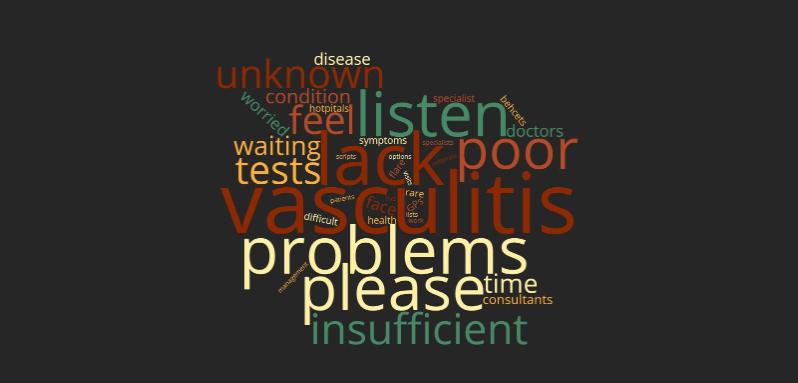
Vasculitis care in Northern Ireland
Evaluating and improving the care and support for vasculitis patients in Northern Ireland
Vasculitis is a group of rare, auto immune, systemic diseases where the immune system attacks the blood vessel walls. Vasculitis is typically treatable, but often has a complex clinical presentation and variable disease course that makes managing this condition challenging in routine healthcare settings. For many individuals, living with vasculitis is an ongoing, life-changing challenge that significantly affects their day-day experiences. Researchers are trying to improve the care for people with vasculitis from diagnosis through to the effective management of the condition. This patient-initiated study will give vasculitis patients and healthcare professionals a chance to express their opinion on vasculitis care.
Read more Read less
New approaches to help diagnose and treat rare diseases
We are researching 'multiomics' as a new approach to improve the diagnosis and treatment for rare diseases
Katie Kerr joined our team as a PhD student (2017-2020) researching 'multiomics' as a new approach to improve the diagnosis and treatment of rare diseases.
Katie is working within our collaborative, multidisciplinary team, which includes input from clinical, academic, and industrial colleagues, as well as patients, carers, and rare disease support groups.
Read more Read less-800x533.jpeg)
-600x399.png)
-600x399.png)
-600x399.png)
-600x399.png)